
Ceramic vs Porcelain vs Opal Glass: Which Dinnerware Is Best for Everyday Indian Food?
Choosing dinnerware for an Indian home is not only about selecting a colour or pattern. Your plates and bowls may hold hot dal, turmeric-rich curries, oily gravies, rice, rotis, chutneys, desserts and everyday snacks. They may also move between the dining table, refrigerator, microwave and dishwasher—provided the exact product is approved for those uses.
That is why the search for the best dinnerware material does not have one universal answer. Ceramic, porcelain and opal glass can all work well, but they offer different combinations of appearance, weight, handling, care and everyday convenience.
This dinnerware material comparison explains the practical differences between ceramic, porcelain and opal glass, how each performs with everyday Indian food and what you should verify before buying a dinner set online.
Quick answer: which dinnerware material is best for Indian food?
Porcelain is a strong all-round choice when you want a refined finish, relatively dense construction and dinnerware suitable for both daily meals and formal settings. Stoneware and other ceramic dinnerware are ideal when you prefer substantial forms, reactive glazes and a warm handcrafted appearance. Opal glass suits households looking for lightweight, smooth and easy-to-handle everyday dinnerware.
However, material alone cannot confirm food safety, microwave suitability, dishwasher suitability, resistance to staining or protection against thermal shock. Always check the exact product page, packaging and care instructions.
Ceramic, porcelain and opal glass at a glance
| Factor | Ceramic or stoneware | Porcelain | Opal glass |
|---|---|---|---|
| Material family | Ceramic | A type of ceramic | Glass-based tableware |
| Typical appearance | Earthy, substantial, glazed or matte | Smooth, refined and often slimmer | Uniform, smooth and usually opaque |
| Typical weight | Often heavier | Can feel lighter for a similar profile | Often lightweight |
| Design character | Reactive glazes, speckles and natural variation | Refined colours, clean forms and detailed decoration | Consistent colour and printed patterns |
| Indian-food presentation | Excellent contrast for curries, rice and complete meals | Versatile for daily and formal meals | Clean, familiar everyday presentation |
| Stain management | Depends heavily on glaze and finish | Dense, smooth surfaces are generally easier to maintain | Smooth surfaces are generally easy to wipe clean |
| Microwave or dishwasher use | Only when the exact product permits it | Only when the exact product permits it | Only when the exact product permits it |
| Main buying check | Glaze quality, finish, care and natural variation | Product thickness, decoration and care | Strengthening method, care and intended appliance use |
These are general tendencies, not guarantees. Construction, thickness, edge design, decoration, glaze, quality control and intended use can change how an individual product performs.
What is ceramic dinnerware?
“Ceramic” is a broad material category rather than one single type of plate. Earthenware, stoneware and porcelain are all ceramic materials, although online listings often use “ceramic” to describe earthenware or stoneware products and list porcelain separately.
Ceramic dinnerware is usually made by shaping a clay-based body, firing it and often applying a glaze. The University of Maryland’s materials-science overview describes ceramics as typically hard and chemically non-reactive materials that are formed or densified using heat.
Why people choose ceramic dinnerware
What to check before buying ceramic plates
Look closely at the food-contact surface, rim, base and glaze. A reactive glaze may create normal differences in tone, speckling and edge colour, but it should not be confused with cracks, sharp chips, loose decoration or an uncertain rough food-contact surface.
Do not assume that every ceramic plate is microwave-safe, dishwasher-safe, oven-safe or resistant to sudden temperature changes. Those are separate product claims.
What is porcelain dinnerware?
Porcelain is a type of ceramic generally associated with a refined clay body, higher firing temperatures and a dense, smooth finish. Its exact composition and firing process vary between manufacturers, so “porcelain” should not be treated as a complete product specification by itself.
In a ceramic vs porcelain dinnerware comparison, porcelain commonly feels more refined and can achieve slimmer profiles without appearing visually heavy. Ceramic stoneware often feels more substantial and displays stronger glaze variation.
Why people choose porcelain dinnerware
Is porcelain better than ceramic?
Porcelain is ceramic, so the better question is whether porcelain or another ceramic body suits your household more effectively.
Choose porcelain when you want a refined finish, cleaner visual lines and an easy transition between everyday and formal dining. Choose stoneware or another ceramic body when you prefer a more substantial feel, expressive glaze and handcrafted character.
The winner in a ceramic vs porcelain dinnerware decision should be based on the exact product’s construction, care instructions, piece configuration and intended use—not the category name alone.
What is opal glass dinnerware?
Opal glass dinnerware is made from an opaque glass-based material. It is visually different from clear glass and is commonly used for lightweight plates, bowls and complete dinner sets.
Opal glass is not porcelain and should not automatically be described as ceramic. Some products may be strengthened or toughened through a manufacturer-specific process, but “opal glass” alone does not mean unbreakable.
Why people choose opal glass
What to check before buying opal glass
Confirm whether the exact set is strengthened, microwave-safe or dishwasher-safe. Inspect the rim design and product weight, and read the replacement and care policy. Avoid rewriting “chip-resistant” or “toughened” as “unbreakable.”
Ceramic vs porcelain vs opal glass for everyday Indian food
Indian meals create practical demands that generic dinnerware guides often overlook. The best plates for Indian food need enough usable surface area, suitable bowls for gravies and accompaniments, manageable weight and care instructions that match the household’s routine.
1. For dal, curry and oily gravies
Use bowls with sufficient depth and stable bases. A smooth, intact food-contact surface is easier to clean after oil- and spice-rich dishes. The bowl’s capacity matters as much as its material: a small katori serves an individual portion, while a larger bowl belongs at the centre of the table.
2. For turmeric-rich food
Turmeric can leave visible residue, particularly when food remains on a surface for an extended period. Prompt cleaning according to the manufacturer’s instructions is more useful than declaring one material completely stain-proof.
Do not use steel wool or harsh abrasives unless the product manufacturer explicitly permits them. Aggressive scrubbing may affect a decorated or glazed surface.
3. For rotis, rice and complete thalis
Look beyond the advertised diameter and examine the usable eating area. A wide rim can reduce the central space available for food. A 25 cm dinner plate with a restrained rim can comfortably support rice, vegetables, rotis and small accompaniments, depending on the meal and serving style.
4. For chutneys, curd and desserts
Individual katoris help separate wet accompaniments from dry food. For a family of six, a coordinated set with six small bowls makes portioning and table arrangement easier.
5. For reheating food
Use the microwave only when the exact product is confirmed microwave-safe. Metallic rims, metallic-looking decoration and some applied finishes require special caution. Microwave-safe does not mean oven-safe, safe over direct flame or immune to thermal shock.
Avoid moving unusually cold dinnerware directly into extreme heat. Sudden temperature changes can create stress even in products intended for hot food.
Which material is easiest to maintain?
Maintenance depends on the finish and product instructions more than the broad material label.
Ceramic and stoneware care
Porcelain care
Opal glass care
Which material is safest for dinnerware?
No honest dinnerware material comparison should label every product within one material family as automatically safe.
Food-contact suitability depends on the complete product: its body, glaze or surface, colourants, decoration, firing, quality control, intended use and migration testing. India’s Bureau of Indian Standards maintains a standard addressing lead and cadmium release from ceramicware in contact with food. The US Food and Drug Administration also distinguishes food-use ceramicware from decorative pottery and warns against using pottery with leachable lead for cooking, serving or food storage.
Before buying, look for:
- A clear statement that the product is intended for food contact.
- Material information rather than only decorative marketing terms.
- Product-specific microwave and dishwasher guidance.
- Care instructions for glaze, print or metallic decoration.
- Manufacturer or seller contact information.
- Reliable compliance or test documentation for any strong safety claim.
- A clear warning if the item is decorative and not intended for food.
Terms such as “food-safe,” “lead-free,” “cadmium-free” and “non-toxic” should be supported by the exact product’s documentation. A brand should not apply them to an entire catalogue without suitable evidence.
Which dinnerware is best for different households?
Choose ceramic or stoneware if:
Choose porcelain if:
Choose opal glass if:
How many pieces should an Indian family buy?
Material is only one part of choosing the best dinnerware material and set. The piece configuration must match how your household eats.
For a family of six, a practical 14-piece set can include:
This arrangement supports six place settings and two central dishes without displaying unnecessary components.
A 20-piece dinner set may add six quarter plates for breakfast, snacks, starters, rotis or dessert. Those quarter plates do not need to remain on the table throughout the entire meal.
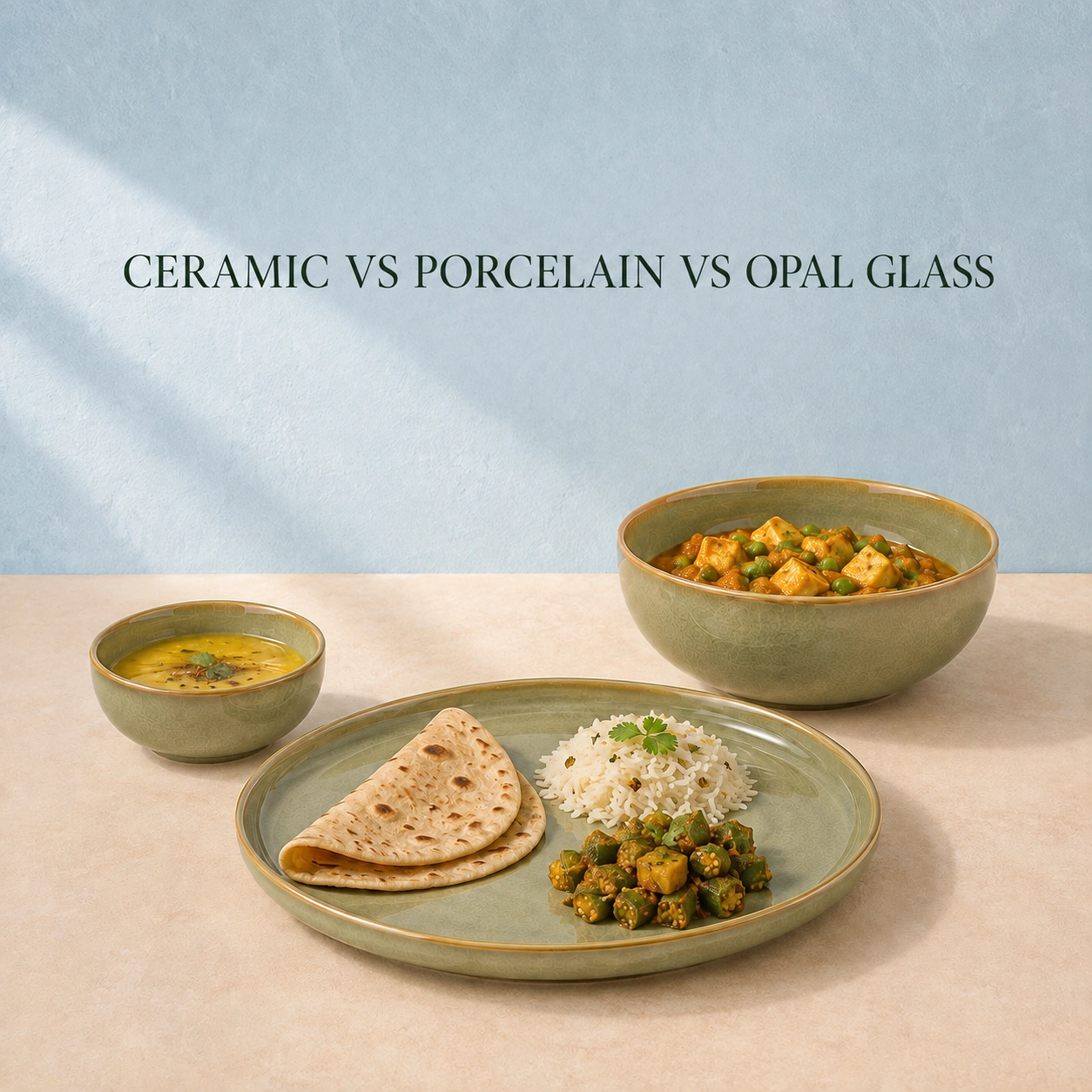
Explore the nestcase Dinner Sets collection for coordinated configurations. The nestcase Speckled-Green 14-Piece Dinner Set demonstrates the six-plate, six-katori and two-serving-bowl format. Reconfirm its current material declaration, stock and care instructions before purchase or publication.
What should you check before buying a dinner set online?
Use this checklist before deciding between porcelain vs opal glass, stoneware or another ceramic option:
For individual components, explore nestcase Bowls & Platters and nestcase Cups & Mugs. Use product links only after reconfirming their material, quantities, care guidance and availability.
Final verdict
There is no single winner for every household.
The best choice is the product that matches your meal habits, handling preferences, appliance use and care routine—and backs its food-contact claims with reliable information.
When comparing the best plates for Indian food, examine the usable plate area, bowl capacities, surface finish and exact care instructions. Material matters, but a well-designed configuration and transparent product information matter just as much.
Frequently asked questions
Is porcelain better than ceramic for everyday use?
Porcelain is a type of ceramic. It commonly offers a dense, smooth and refined finish, while stoneware and other ceramic products may feel more substantial and show greater glaze variation. The better option depends on the exact product and your handling preferences.
Is opal glass better than porcelain?
Neither is universally better. In a porcelain vs opal glass comparison, porcelain may suit shoppers wanting refined profiles and ceramic character, while opal glass may suit those prioritising lightweight handling and uniformity.
What is the best dinnerware material for Indian food?
Porcelain, stoneware ceramic and opal glass can all work for Indian food. Check the plate’s usable area, bowl depth, food-contact suitability, glaze or surface finish and care instructions before choosing.
Which dinnerware is best for turmeric and curry?
Choose dinnerware with a smooth, intact food-contact surface and clear cleaning guidance. Clean turmeric- and oil-rich food promptly. No material should be described as universally stain-proof without product-specific evidence.
Is ceramic dinnerware food-safe?
Ceramic dinnerware can be suitable for food when it is manufactured and tested for that purpose. Do not use ornamental pottery or a product marked “not for food use.” Safety depends on the complete product, including its glaze and decoration.
Can ceramic and porcelain go in the microwave?
Only when the exact product says it is microwave-safe. Do not infer microwave suitability from the material name. Metallic rims and some decorations require additional caution.
Is opal glass unbreakable?
No general material claim makes every opal glass product unbreakable. Some products may be strengthened or toughened, but they can still be damaged. Follow the manufacturer’s handling instructions.
What is the difference between porcelain and stoneware?
Both are ceramics. Porcelain is generally associated with a refined, dense body and smooth finish. Stoneware commonly has a heavier feel and is often used with reactive or earthy glazes. Exact performance varies by product.
Which dinner set is suitable for a family of six?
A 14-piece set with six dinner plates, six individual katoris and two serving bowls is a practical starting point. A 20-piece set adds quarter plates for snacks, starters, rotis or dessert.
When should a plate or bowl be replaced?
Remove dinnerware from food use if it has a structural crack, sharp chip, loose decoration or an uncertain damaged food-contact surface. Do not continue using a damaged piece merely because it still holds food.
Explore considered everyday dinnerware
Choose dinnerware by looking beyond colour alone. Compare the material, component count, dimensions, bowl capacities, food-contact information and care instructions before ordering.
Explore nestcase Dinner Sets, Bowls & Platters and Cups & Mugs to build an everyday table around the way your family actually eats.