
From Banana Leaves to Katoris: How India Serves a Meal Across Regions
India does not have one dining table, one thali or even one idea of what a complete meal should look like. A festive lunch in Kerala may unfold across a banana leaf, while a Gujarati thali may bring many contrasting flavours together in small portions. In a Punjabi home, bowls of dal and sabzi may sit at the centre for everyone to share. In Bengal, a meal may arrive in a thoughtful progression rather than all at once.
These differences are what make regional Indian dining traditions so fascinating. The plate, leaf, bowl, serving order and person offering the next helping can all carry meaning. They tell stories about local crops, climate, community, celebration and the habits passed from one generation to another.
This visual and cultural guide explores how food is served in different parts of India. It is not a rulebook. Practices differ between religions, communities, districts, occasions and individual homes—even within the same state. Think of it as an invitation to notice the tableware, rhythm and hospitality surrounding a meal, not only the recipes placed on it.
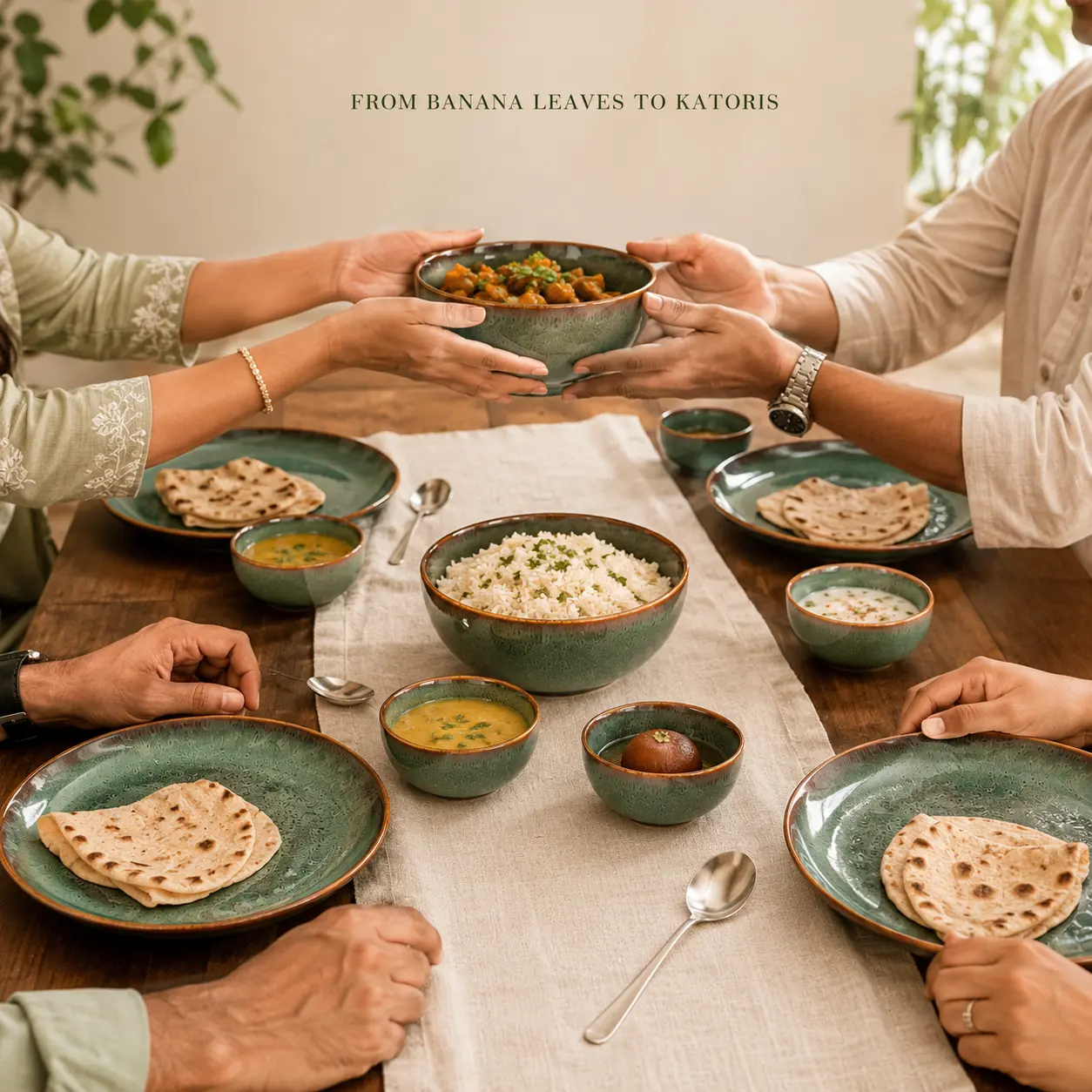
Across India, a meal is rarely arranged by food alone. The plate, bowl, leaf, serving order and person passing the next helping all carry a little piece of home.
India Does Not Have One Traditional Table Setting
The phrase traditional Indian table setting can be misleading if it suggests one standard arrangement. India’s dining cultures have developed around different staple grains, produce, weather conditions, occupations, ceremonies and household structures.
Rice may anchor one meal while rotis or other breads anchor another. Some foods are served together in a thali; others arrive as courses. Certain celebrations call for a banana leaf, metal thali or another traditional surface, while everyday meals may now use ceramic plates and bowls. Many families combine inherited customs with the convenience of a contemporary dining table.
That flexibility is part of the story. Indian food serving styles are living traditions. They can retain their emotional centre even when the vessels, furniture or daily routine change.
Maharashtra: Everyday Order and Festive Warmth
A Maharashtrian meal can look different in Pune, Konkan, Vidarbha, Marathwada or Mumbai, and festive arrangements may differ significantly from weekday dining. Yet one familiar visual is a generous plate supported by smaller portions of dal-like preparations, vegetables, chutneys, pickles, curd or sweets.
Rice and bread-based elements may share the plate, while liquid preparations are easier to manage in separate katoris. At celebrations, the number of preparations can grow and the placement may follow a family custom. Banana leaves are also used for particular occasions in some Maharashtrian communities, including festive meals.
The emotional centre is often not abundance for display, but the act of आग्रह—warmly encouraging a guest to eat a little more. A modern Maharashtrian-inspired table can preserve that feeling through a spacious plate, small bowls for contrasting preparations and shared serving bowls placed within easy reach.
Modern tableware translation: Use a 25 cm dinner plate for the main meal, 220 ml katoris for amti, curd or dessert, and larger serving bowls for shared preparations. Keep cultural motifs restrained unless they are accurately researched and credited.
Gujarat: Many Flavours in One Complete View
The Gujarati thali is widely recognised for presenting several preparations together, often balancing sweet, sour, salty and spicy notes. The exact dishes and arrangement vary by region, season, community and household, but its visual character frequently comes from multiple smaller portions surrounding bread, rice or other central elements.
This is where the practical intelligence of a thali becomes visible. Small bowls prevent liquid foods from mixing too early. Dry preparations can remain distinct on the plate. Pickles and accompaniments need only a little space, while shared dishes can be replenished as the meal continues.
For anyone studying Indian thali traditions, Gujarat demonstrates that variety does not require disorder. Repetition in bowl size creates visual unity, while the food supplies colour and contrast.
Modern tableware translation: Begin with one generous plate and use matching small bowls for preparations that should remain separate. Avoid overcrowding; a smaller first serving can be replenished.
Rajasthan: Serving Shaped by Landscape and Resourcefulness
Rajasthani food traditions reflect enormous internal diversity, from royal and urban influences to pastoral, desert and community-specific cooking. In areas where water and fresh produce were historically less predictable, preservation-friendly ingredients and dry preparations became especially important.
On the table, breads, lentils, vegetable dishes, chutneys and sweets may be arranged so that dry and liquid components remain practical to eat together. A broad plate offers space for breads, while bowls help contain dal, kadhi or other fluid preparations. Shared vessels support the generous refilling associated with family meals and hospitality.
The lesson for contemporary dining is not to recreate a “rustic Rajasthan” aesthetic using unrelated props. It is to understand why the meal works: appropriate vessels, clear separation of textures and serving pieces that can move easily around the table.
Punjab and North India: The Warmth of Shared Bowls
Across Punjab and many North Indian homes, family-style serving is a familiar sight: breads arrive warm, while dal, sabzi, rice, raita and pickles are placed where everyone can reach them. This is not a universal arrangement, but it captures a strong idea within regional Indian dining traditions—the meal belongs to the whole table.
Large serving bowls make repeated helpings easy. Individual bowls keep dal, raita or dessert contained. Quarter plates can hold rotis, starters or sweets without crowding the main dinner plate.
The styling should remain secondary to the food and interaction. One or two shared bowls, a stack of breads and enough clear space to pass dishes can feel more welcoming than an elaborate but impractical tablescape.
Modern tableware translation: A coordinated 14-piece set can support a simple family meal with plates, individual bowls and two shared dishes. A 20-piece set becomes useful when separate quarter plates are regularly needed for breads, starters or desserts.
West Bengal: A Meal That Can Unfold in Stages
Bengali dining traditions vary across families, communities and the wider Bengal region. A recurring characteristic in many accounts, however, is progression: bitter or vegetable preparations, dal, fish or other main dishes, chutney and sweets may be served in a considered order rather than placed together without sequence.
Rice often provides the centre around which the meal develops. Bowls help organise liquid dishes, but the rhythm of serving is equally important. A course is enjoyed, the plate changes, and the next flavour arrives.
This makes the Bengali table a valuable reminder that how food is served in different parts of India is not only about which plate is used. Timing is also a form of table setting.
Modern tableware translation: Keep the dinner plate visually open, use individual bowls for liquid preparations where suitable, and bring shared dishes to the table in the intended order instead of displaying everything at once.
Odisha: Balance Without Unnecessary Display
Odisha’s food cultures include temple traditions, coastal cooking, everyday rice-and-dal combinations and numerous community-specific practices. A meal may bring together rice, dal, vegetables, leafy preparations, fermented or seasonal elements and sweets, depending on the household and occasion.
The visual strength of such a setting can come from clarity rather than excess. Each preparation has enough room to remain identifiable. Small portions allow the diner to experience different flavours without immediately mixing every component.
For a modern table, the lesson is simple: do not confuse celebration with crowding. A well-spaced plate and a few properly sized bowls can express care more effectively than decorative objects that interrupt serving.
Kerala: The Visual Rhythm of a Banana-Leaf Feast
Among the most recognisable regional Indian dining traditions is Kerala’s Sadya, a vegetarian feast commonly associated with occasions such as Onam, Vishu, weddings and other gatherings. It is traditionally served on a banana leaf, with multiple preparations placed in an organised arrangement and served through the course of the meal.
Sadya should not be reduced to a Pinterest colour palette. The leaf, placement, serving sequence and dishes belong to a living cultural practice. Details can vary by locality and family, so anyone recreating the meal should follow a reliable regional source or their own household tradition.
The broader design lesson is the relationship between order and abundance. Many items can appear together without looking chaotic when each has an expected place and suitable portion.
Modern tableware translation: When a banana leaf is unavailable or not part of the household’s practice, a large plate with small bowls can support a contemporary Kerala-inspired meal—but it should be described as an adaptation, not an authentic Sadya setting.
Tamil Nadu: A Meal Organised Around Rice and Courses
Tamil dining customs differ across communities, districts and occasions. Banana-leaf service is important in many festive, wedding and ceremonial contexts, while ordinary household meals may use plates and bowls. Rice can be served with a progression of accompaniments and liquid preparations, with curd or buttermilk-related elements often appearing toward the later part of a meal in some traditions.
The serving surface works like a map: dry accompaniments remain separate, rice occupies usable space, and liquids are introduced in manageable quantities. The system is practical because it anticipates how the meal will actually be eaten.
A contemporary ceramic setting can borrow this functional thinking—clear zones, modest portions and staged serving—without pretending that a plate and bowls reproduce banana-leaf etiquette exactly.
Karnataka: One State, Many Dining Languages
Karnataka cannot be represented by one thali. Coastal Karnataka, Kodagu, North Karnataka, the Mysuru region and Bengaluru’s mixed urban households carry different staples, flavours and serving customs. Rice-based meals, millet or sorghum breads, vegetable palyas, gravies, rasam-like preparations, curd and sweets may appear in different combinations.
This diversity illustrates why regional guides must avoid treating state borders as culinary boundaries. Even the same dish may be prepared, named or served differently across neighbouring communities.
Modern tableware translation: Choose vessels by consistency and portion rather than forcing every dish into an identical bowl. A flatter plate suits breads and dry items, while deeper bowls support gravies, curd and desserts.
Assam and Northeast India: Look Beyond a Single “Northeastern Thali”
The Northeast includes many states, peoples, languages and food cultures; it should never be compressed into one generic table. Rice is important across numerous communities, but accompanying vegetables, meats, fish, fermented foods, herbs and cooking methods differ widely.
In Assam, banana leaves and other plant materials may be used in certain festive or traditional food contexts, while plates and bowls are common in contemporary homes. Elsewhere in the Northeast, bamboo, leaves, wood, metal, ceramic and modern dinnerware can all appear depending on community and occasion.
The most respectful visual approach is specificity. Name the state, community and occasion being represented. Research the dishes and vessels independently. Avoid combining unrelated textiles, motifs and foods simply because they come from the same broad part of India.
What Regional Indian Meals Often Share
The details change, but several ideas frequently connect Indian food serving styles:
This is why no single “correct” traditional Indian table setting can represent the country. The common thread is thoughtful service.
How to Create a Regional Indian Meal Respectfully
If you want to explore how food is served in different parts of India at home, begin with curiosity rather than decoration.
1. Choose one specific tradition
Research a state, sub-region, community and occasion. “South Indian” or “North Indian” is usually too broad to guide an accurate table.
2. Learn the meal’s serving logic
Find out whether dishes are served together or in stages, which foods should stay separate and whether a leaf, thali, plate or bowl has a particular role.
3. Do not mix symbols casually
A textile from one region, food from another and ceremonial motif from a third may create an attractive photograph but a confusing cultural story.
4. Describe modern interpretations honestly
If you use ceramic dinnerware instead of a traditional serving surface, call it a contemporary regional-inspired meal—not an authentic recreation.
5. Let food remain visible
Use low, manageable portions and keep rims and patterns visible without sacrificing eating space. Tableware should support the meal rather than compete with it.
6. Choose bowls by function
For a contemporary family setting, nestcase 220 ml small bowls can help separate curd, dal, dessert or side portions. Floral Blue 750 ml serving bowls can hold suitable shared preparations. Always follow the exact product-care instructions.
7. Leave room for people
The most beautiful setting still needs space for hands to pass bowls, place breads and serve another helping.
Bringing Regional Warmth to a Modern Indian Table
Modern dinnerware does not need to imitate traditional objects to feel connected to India. It can honour the logic behind them: separation where needed, generosity where shared, and beauty that remains useful every day.
A Floral Blue Dinner Plate Set can frame a colourful Indian meal without prescribing one region. A Speckled Green 14-Piece Dinner Set provides six plates, six small katoris and two serving bowls for a coordinated family table. For meals that regularly need separate starter, bread or dessert plates, the Blue 20-Piece Dinner Set adds six quarter plates.
The right choice is not the set that looks most elaborate. It is the one that suits how your family serves, shares and eats.
A Table Is Also a Memory
Ask someone about a childhood meal and they may remember more than taste. They may remember the steel katori that always held dal, the banana leaf washed before a festival lunch, the bowl placed in the centre for everyone, or a grandmother insisting on one final spoonful.
That is the deeper meaning of regional Indian dining traditions. Tableware becomes part of memory because it participates in care. Across states, communities and generations, the materials and arrangements may change, but the gesture remains familiar: food is prepared, placed before someone and offered with warmth.
India serves a meal in countless ways. Yet wherever the plate is set, home often begins with the same question: “Would you like a little more?”
Frequently Asked Questions
What are regional Indian dining traditions?
Regional Indian dining traditions are the serving practices, vessels, meal sequences and hospitality customs associated with particular Indian communities and occasions. They vary within every state and should not be treated as fixed rules.
How is food served in different parts of India?
Food may be served on banana leaves, thalis, plates or in bowls; placed together or brought in courses; and divided between individual and shared vessels. The method depends on region, community, household and occasion.
Is every Indian meal served in a thali?
No. A thali is an important and widely recognised format, but Indian households use many arrangements, including plates with shared bowls, banana-leaf meals and course-based service.
Why are small bowls or katoris used in Indian meals?
Katoris help keep liquid or contrasting preparations such as dal, curry, curd, chutney and dessert separate until the diner chooses to combine them.
Which regions serve food on banana leaves?
Banana-leaf service appears in several parts of India, especially in southern and eastern regions and for certain festive or ceremonial meals. Specific placement and etiquette vary, so follow the relevant local or family tradition.
What is the difference between a thali and a dinner plate?
“Thali” can refer to a serving platter and also to a complete meal containing several dishes. A dinner plate generally holds one person’s main meal and may be accompanied by separate bowls.
Can ceramic dinnerware be used for regional Indian meals?
Yes. Ceramic plates and bowls can support contemporary versions of regional meals when chosen according to portion, texture and serving needs. They should not be described as traditional substitutes where a particular leaf or vessel has cultural significance.
How many bowls are useful for an Indian meal?
It depends on the menu. A simple meal may need one individual bowl and one or two shared bowls; a multi-dish thali may require several small bowls to keep preparations separate.
How can I avoid cultural stereotyping in a regional table setting?
Research a specific community and occasion, use accurate names, avoid mixing unrelated symbols and clearly label modern interpretations. When possible, learn from people who practise the tradition.
What is common across Indian dining cultures?
Although practices differ, shared food, thoughtful portioning, repeated helpings and hospitality appear across many Indian dining cultures.